Concrete fencing for garden boundaries has become the go-to choice for homeowners who are tired of replacing rotten timber every few years. Whether you are marking out a back garden, a side return, or the boundary between you and a neighbour, a concrete post and panel fence gives you a straight, secure line that does not need repainting, treating or propping up after a bad storm. This guide walks through everything you need to plan a garden boundary fence properly, from the parts involved to how it all goes together, drawing on what we see day to day supplying gardens across Gainsborough, Lincolnshire and the wider East Midlands.
Why Concrete Suits a Garden Boundary So Well
A garden boundary fence has one job above all others: to stay where you put it. Timber posts, especially where they meet damp soil, tend to rot from the base within ten to fifteen years, leaning gradually until a panel comes down in the wind. Steel-reinforced concrete fence posts do not rot, warp or work loose in the ground, which means the fence you put up this year still looks and performs the same way in twenty or thirty years. For a garden boundary, where access for replacement work can mean disturbing beds, patios or a neighbour's side of the fence, that long-term reliability matters more than it does almost anywhere else on a property.
The Building Blocks of a Concrete Garden Fence
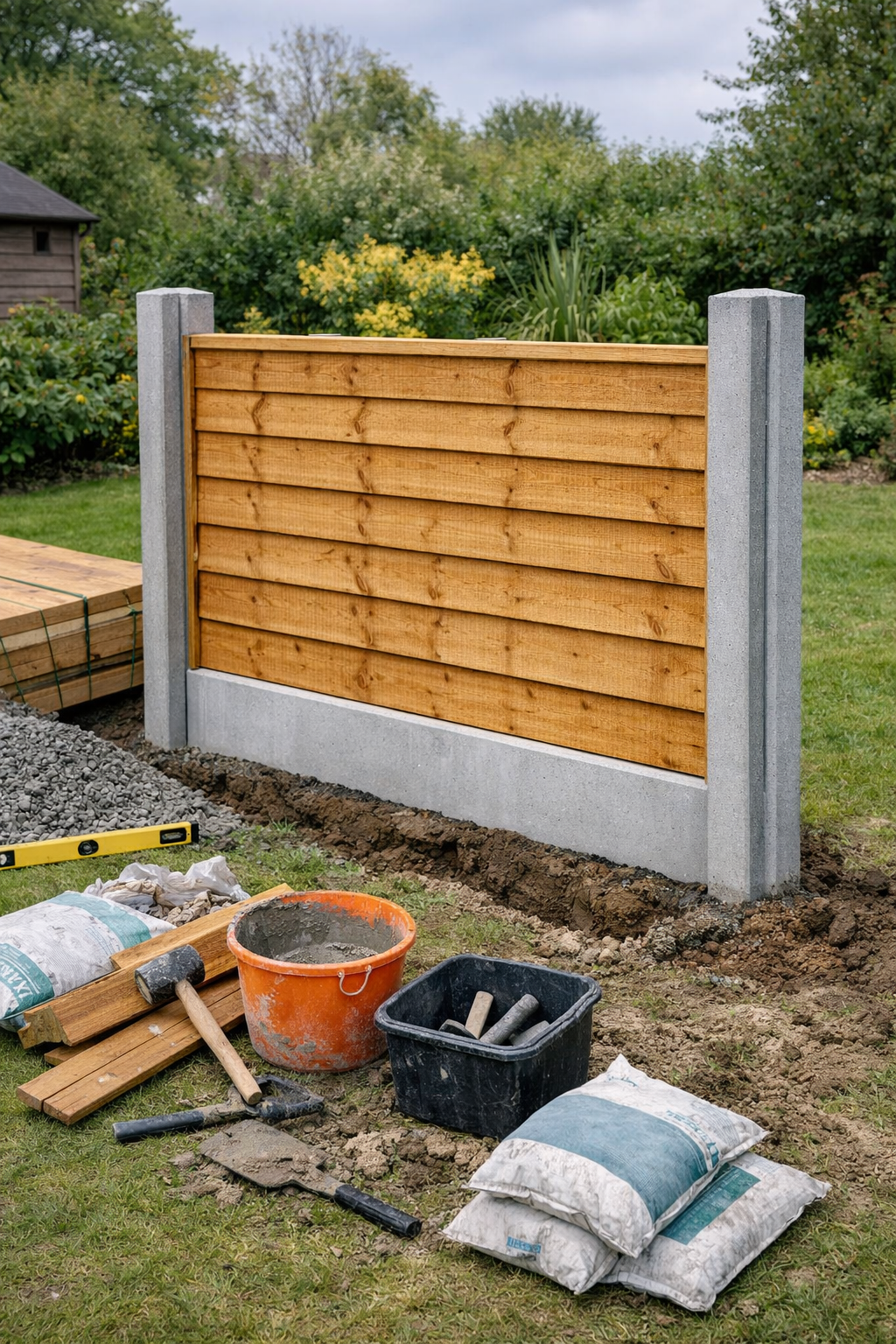
A typical concrete garden boundary is made up of three parts working together. Concrete fence posts, slotted or morticed to hold panels, form the structural frame along the boundary line. Timber or concrete panels fill the bays between posts and give you the privacy or screening you actually want from the fence. A gravel board sits at the base of each bay, lifting the panel clear of the soil so it stays dry and the panel itself lasts far longer, since panel rot almost always starts at ground level. Using concrete for the posts and gravel boards, and timber panels above, is the most common and cost-effective combination for a garden boundary, giving you the low maintenance of concrete where it matters most.
Sizing Your Garden Boundary Fence
Most garden boundaries in the UK use 6ft (1.83m) wide panels, so posts are set at matching centres along the run. Post height depends on your finished fence height plus the depth needed in the ground, typically around a third of the post's total length, so a 6ft fence generally needs a post closer to 8ft overall. If your garden is on sloping ground, which is common across parts of rural Lincolnshire, you will need to either step the fence down in level sections or rake it to follow the slope, both of which affect how posts are set. For the full breakdown of post sizes and spacing, see our guides on what size post you need for 6ft panels and concrete fence post spacing.
Planning Corners, Gates and Neighbouring Boundaries
Before ordering anything, walk the full boundary line and note where it turns a corner, where a gate needs to go, and where it meets a shared fence with a neighbour. Corner posts are grooved on two adjacent faces rather than one, and gate posts are usually a heavier post set to cope with the extra load of an opening panel. It is worth agreeing shared boundary work with a neighbour before you start, particularly if the existing fence sits on the legal boundary line, to avoid any dispute once concrete is in the ground. Planning these fixed points first, then spacing the regular run of posts evenly between them, gives a far tidier result than working from one end and hoping the last bay fits.
What Installation Involves
Installing a concrete garden fence follows a consistent process: marking out the line with string and pegs, digging post holes to roughly a third of the post's height, setting each post in postcrete or a concrete footing and checking it is plumb with a spirit level, then fitting gravel boards and panels once the concrete has cured. A typical domestic garden boundary can usually be completed over a weekend by two people, though corners, gates and sloped sections add time. We cover the step-by-step process in full in our guide to building a concrete panel fence, including footing depths and curing times.
Once it is up, a concrete garden boundary needs very little looking after. An occasional check of panels and a jet wash to clear algae is generally all that is required; our guide to maintaining a concrete fence covers this in more detail. If your project also includes a patio, path or shed base alongside the new boundary, our concrete slabs make a matching low-maintenance choice for the hard standing.
A well-planned concrete garden boundary is one of the few improvements you make to a property that you genuinely do not have to think about again for decades. Getting the sizing, spacing and planning right before you order saves time, materials and a fair bit of frustration once digging starts.
Planning a new garden boundary fence?
Tell us your boundary length and we will help you work out posts, panels and gravel boards, with current pricing on our prices page. We supply concrete fence posts, gravel boards and slabs across Lincolnshire, South Yorkshire and North Nottinghamshire. Call or WhatsApp us on 07989 192742, or get in touch below.
Get in Touch