Concrete fence post spacing is the one measurement that decides how well the rest of your fence goes together. Get it right and every panel, gravel board and post lines up without a fight. Get it wrong and you end up cutting panels down, leaving gaps, or finding out halfway along a run that your last bay does not fit. Whether you are fencing a garden in Gainsborough or a paddock boundary further out into Lincolnshire, here is exactly how far apart concrete fence posts should be, and why.
The Standard Rule: Match Post Spacing to Your Panel Width
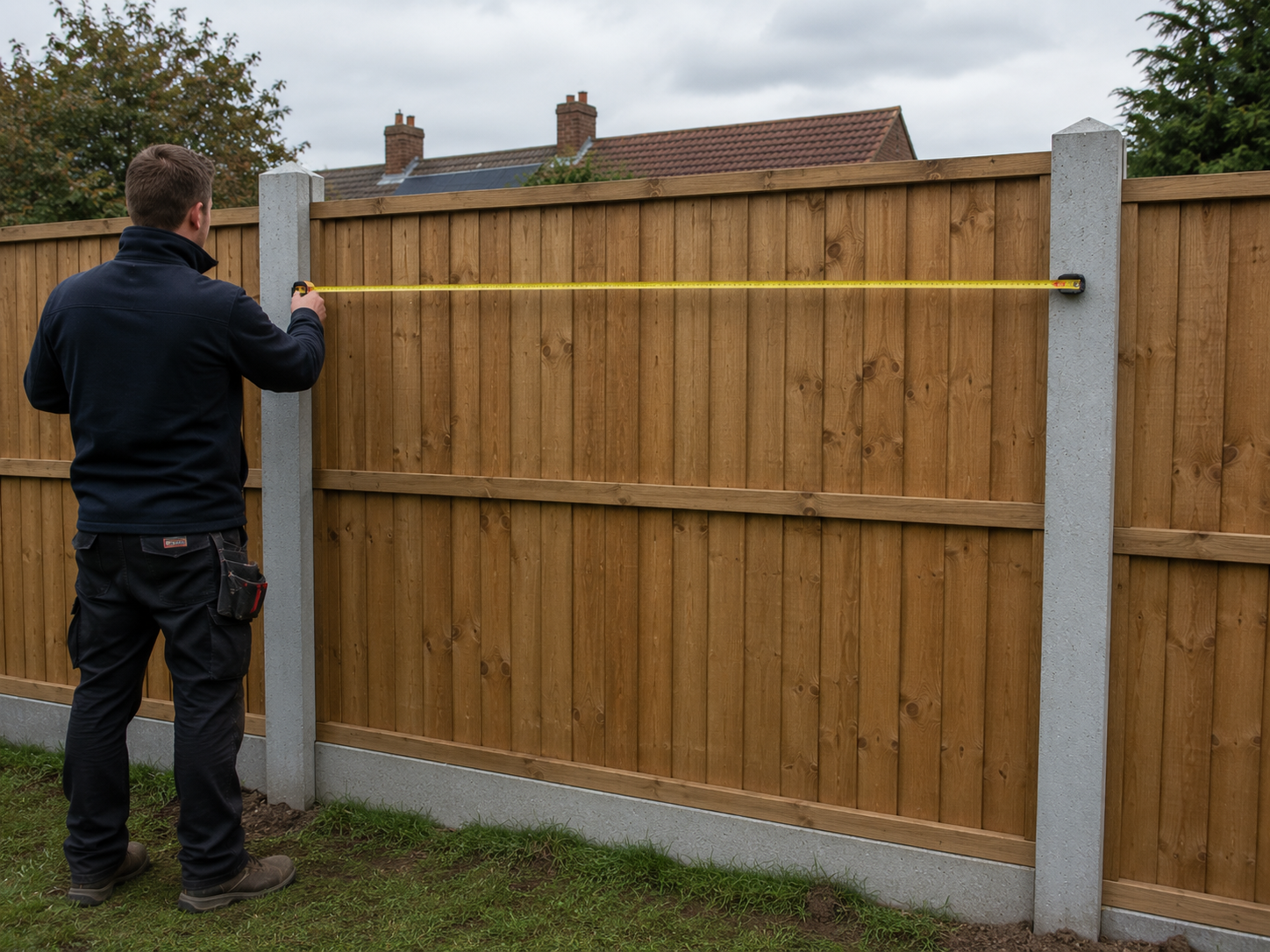
Concrete fence post spacing should always be set by the panels you are fitting, not the other way around. In the UK, most fence panels are a standard 1.83m (6ft) wide, so post centres are set at 1.83m to match, measured from the centre of one post to the centre of the next. Because concrete fence posts use a slotted or morticed design, the panel sits inside the post rather than butting against it, so the true gap between posts is slightly less than 1.83m once the post width is accounted for. Always check the panel width you are actually buying before setting out post positions, since some suppliers use slightly different standard sizes.
Recommended Spacing by Fence Height
Panel width is the main driver for garden fencing, but spacing can also flex slightly depending on the overall height and purpose of the fence:
- Under 1m (3ft): 1.5m to 1.8m between posts is typical for low boundary or decorative fencing.
- 1m to 1.5m (3ft to 5ft): 1.8m centres is standard, matching a 6ft panel.
- Over 1.5m (5ft), including exposed or rural boundaries: closer spacing, sometimes down to 1.8m to 2.4m, gives extra rigidity against wind loading on taller runs.
For most homes near Gainsborough and across the East Midlands fitting standard 6ft panels, 1.83m post centres is the figure to work to. It is also the spacing we base our guide on how many concrete fence posts you need for a given boundary length.
Corners, Gate Posts and End Posts Need Extra Thought
Straight runs of intermediate posts are the easy part. Corner posts, end posts and gate posts all take more load than a post in the middle of a run, since they are not braced by a panel on both sides. Corner posts use a dedicated corner post (grooved on two adjacent faces) rather than a standard intermediate post, and gate posts are usually a heavier-duty post set slightly closer to its neighbour than the standard panel spacing, to cope with the weight and swing of the gate. If your boundary includes a corner or a gate, plan those post positions first and work the regular panel spacing out from them, rather than the other way around.
Want the exact post count for your own fence line? Try our free concrete fence post calculator — enter your length and get an instant breakdown of posts, panels and gravel boards.
Adjusting Spacing on Sloped or Uneven Ground
On sloping ground, which is common across parts of rural Lincolnshire, panel spacing usually still follows the standard panel width, but the fence itself either steps down in level sections or rakes to follow the slope. Either approach affects how posts are set rather than how far apart they sit, and it is worth reading them together with the spacing rules above. We cover this in detail in our guide to concrete fencing on a slope, including where a gravel board can take up a stepped gap at the base of each bay.
What Happens If Posts Are Spaced Too Far Apart
Spacing posts further apart than the panel allows, to save on post costs, is a common mistake and it rarely works out. Panels are not designed to flex or stretch across a wider gap, so an oversized span leaves the panel unsupported at the edges, prone to bowing, and far more likely to fail in strong wind. Posts spaced too close together, on the other hand, waste materials and leave you cutting panels to fit, which weakens the cut edge. Sticking to the manufacturer's panel width, and buying posts sized to match, avoids both problems.
Getting Your Spacing Right Before You Start Digging
Before any digging starts, mark out the full run of your fence line with string and pegs, measure the total length, and work out how many full 1.83m bays it divides into. Most boundaries do not divide perfectly, so you will usually need to adjust one end bay slightly or plan for a cut panel there rather than compromising the spacing throughout the rest of the run. This upfront planning takes half an hour and saves a lot of frustration once concrete is in the ground. For sizing the posts themselves once your spacing is set, see our guide on what size concrete fence post you need for 6ft panels, and our prices page for current stock.
Getting concrete fence post spacing right is one of the simplest parts of the job to get wrong if it is rushed, and one of the easiest to get right with a bit of planning. If you are unsure how your boundary length divides up, our team near Gainsborough is happy to run through the numbers with you before you order.
Not sure how many posts your boundary needs, or what spacing to use?
Give us your fence line length and we will work out the post count and spacing for you. We supply concrete fence posts, gravel boards and panels across Lincolnshire, South Yorkshire and North Nottinghamshire. Call or WhatsApp us on 07989 192742, or get in touch below.
Get in Touch