Very few gardens are perfectly flat. Across Lincolnshire and the East Midlands, plenty of boundaries run up a gentle rise, drop away toward a field, or follow the fall of a paddock. That leads to one of the most common questions we hear: how do you fit concrete fencing on a slope without ending up with awkward triangular gaps or a fence that looks like it is sliding downhill? The good news is that concrete fence posts and panels handle sloping ground very well once you know the two methods for doing it. As a supplier of steel-reinforced concrete fence posts near Gainsborough, this guide walks through everything you need to plan a neat, solid fence on a slope.
Fencing on a Slope: The Two Main Methods
There are two established ways to run a fence up or down a slope: stepping and raking. Both work with concrete posts and standard fence panels, and the right choice depends on how steep the ground is and the look you are after.
- Stepping keeps every panel level, with each one set slightly higher or lower than its neighbour, creating a stepped, staircase effect along the top of the fence.
- Raking tilts the panels to follow the angle of the ground, so the fence runs parallel with the slope and the top line stays continuous.
Stepping is by far the most common approach with concrete post and panel fencing, and for most gardens on the damp, gently rolling ground around Gainsborough it is the simplest and tidiest option.
Stepping a Concrete Fence Down a Slope
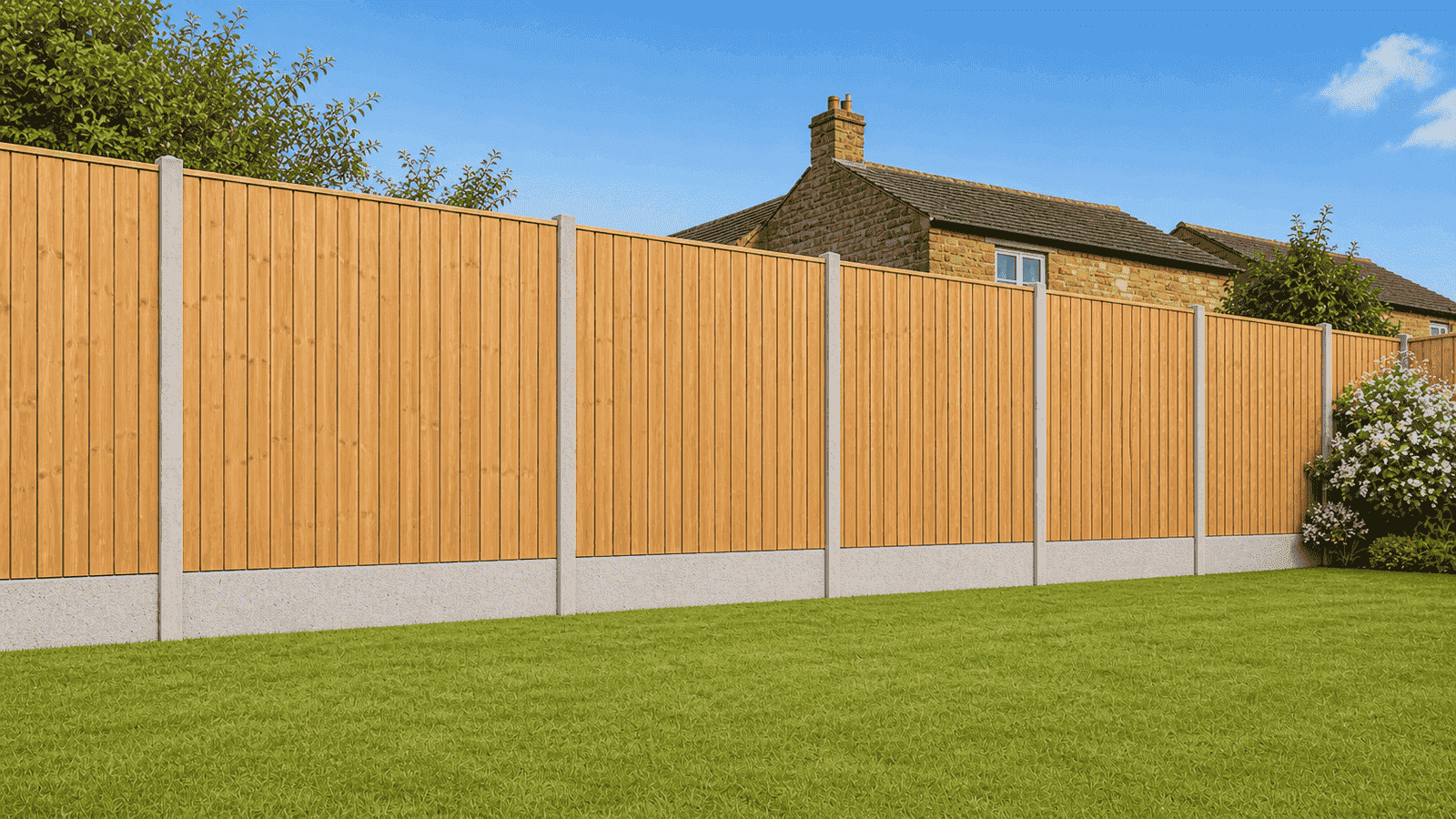
Stepping is the method concrete fencing is made for. Because concrete posts are slotted, the panels simply drop into the channels, and you set each post so its neighbouring panel sits a step up or down from the last. The panels themselves stay perfectly level, which keeps them strong and square.
The trade-off with stepping is that a triangular gap opens up underneath each panel where it steps over the falling ground. This is exactly what gravel boards are for. A concrete gravel board fitted below each panel fills that gap, blocks pets and debris from getting under the fence, and keeps the timber panel clear of wet soil so it does not rot. On a steeper step you can even stack two gravel boards on the low side. For most slopes, stepping with a gravel board at the bottom of every panel gives the cleanest, most durable result.
Raking a Fence to Follow the Ground
Raking suits a long, even slope where a stepped top line would look fussy, or where you want to avoid gaps under the panels altogether. Here the whole panel is tilted to match the gradient, so it runs snug to the ground the entire way. There is no triangular gap to fill, and the fence follows the land in one continuous line.
The catch is that standard pre-made concrete panels and closeboard panels are built square, so true raking often needs purpose-made raking panels or a closeboard fence built board by board on site. It is more labour, and not every panel type will rake cleanly. On very uneven or terraced ground, raking becomes impractical, which is why stepping remains the go-to for most concrete fencing on a slope.
Why Concrete Posts Suit Sloping Ground
Sloping sites are usually the wettest part of a garden, because water drains downhill and gathers at the base of the fence line. That is punishing for timber posts, which rot fastest exactly where they sit in damp ground. Steel-reinforced concrete posts do not rot, so they hold firm on a slope for decades where timber would fail early. Their weight and strength also help them resist the sideways push of soil and wind that a slope can add.
Because concrete posts are slotted on both sides, they lock panels and gravel boards in place and spread the load across the whole run. On a slope, where each panel needs to sit at a slightly different height, that slotted design makes stepping quick and forgiving. You can read more about how long they hold up in our guide on how long concrete fence posts last.
Setting Out and Post Depth on a Slope
Getting the setting out right is what separates a neat slope fence from a wonky one. Run a string line along the boundary first, then measure your post spacing along the slope rather than straight through the air, so the panels fit without forcing.
- Work out your fall: measure the height difference from the top of the run to the bottom, then divide it across your panels to see how big each step needs to be.
- Choose your post height: on the low side of each step the post carries an extra gravel board, so you may need taller posts than you would on flat ground. Allow for this before you order.
- Keep depth consistent: whatever the ground does above, set each post to a firm, consistent depth in concrete. As a rule, bury around a third of the post, and dig deeper on the downhill side where the soil is softer.
If you are unsure how much post to put in the ground, our article on how deep concrete fence posts should be set covers depths for 6ft and 8ft fences. Getting the post count and heights right before you order saves a second trip, and you can check current rates on our prices page.
Common Slope Fencing Mistakes to Avoid
A few slips catch people out on sloping ground. Steer clear of these and your fence will look tidy and last:
- Forgetting the gap: not planning for gravel boards under stepped panels leaves gaps that let animals and debris through. Order a gravel board for every panel from the start.
- Buying posts too short: the low side of a step needs the extra height for the gravel board, so measure the tallest post you will need and order to that.
- Skimping on depth downhill: the downhill side often has looser, wetter soil, so posts there need setting firmly in concrete, not just tamped earth.
- Trying to rake square panels: forcing a standard square panel to follow a slope stresses it and looks off. Step it instead, or use proper raking panels.
Which Method Is Right for Your Garden?
For the vast majority of gardens, paddocks and rural boundaries we supply across Gainsborough, Lincolnshire and the wider East Midlands, stepping concrete posts and panels with a gravel board under each panel is the best answer. It is straightforward to set out, keeps every panel strong and level, and copes with the damp ground that comes with a slope. Save raking for long, steady gradients where a continuous top line really matters and you can source the right panels for it.
If you are planning a fence on sloping ground and are not sure how many posts, panels or gravel boards you need, we are happy to help you work it out. Take a look at our concrete fence posts and gravel boards, or get in touch and we will talk it through.
Fencing a slope and not sure where to start?
Call or WhatsApp us on 07989 192742. We supply steel-reinforced concrete fence posts, gravel boards, and slabs across South Yorkshire, North Lincolnshire, and North Nottinghamshire from our base near Gainsborough. Advice is always free.
Get in Touch