Concrete fencing for farms and rural properties has to work harder than a garden boundary. It faces livestock leaning on it, open weather with nothing to break the wind, and boundary runs that can stretch for hundreds of metres rather than a few panel widths. If you manage land around Gainsborough, across Lincolnshire, or anywhere in the East Midlands, the fencing decision you make now affects how much time and money you spend on repairs for years to come. This guide looks at why concrete consistently outperforms timber for farm and rural fencing, and what to think about when you are pricing up a boundary.
Standing Up to Livestock and Long Boundaries
A field boundary or paddock fence takes a different kind of punishment to a garden fence. Livestock lean, rub and push against posts, and a timber post that has softened at the base will eventually give way under that pressure. Steel-reinforced concrete fence posts hold their strength for the life of the post, so a rail or panel stays firmly anchored even where animals are testing the line every day. For anyone running stock across Lincolnshire's mixed farmland, that reliability matters more than almost anything else in a fencing job.
Built for Exposed, Open Ground
Rural boundaries are usually far more exposed than a garden fence tucked between two houses. Open fields around Gainsborough and the wider East Midlands catch the full force of wind and driving rain with nothing to break it up, and that exposure is exactly what rots a timber post from the base first. Concrete does not absorb moisture the way timber does, so it will not soften, split, or lean over a season or two of bad weather. A concrete boundary fence installed correctly stays true to line even after the roughest winters.
No Rot, No Replacing: Less Downtime on a Working Farm
On a working farm, a broken section of fence is not just an inconvenience, it is a risk. A gap in a field boundary can mean stock straying onto a road or into a neighbour's crop, and every hour spent replacing a rotten post is an hour not spent on the rest of the farm. Timber posts in the heavy, damp soils common across Lincolnshire typically need replacing within 10 to 15 years, often more than one at a time. Concrete posts last 30 years or more with no treating, no painting, and no annual check for soft spots at ground level, which our guide on how long concrete fence posts last covers in more detail. Fewer repairs means fewer trips out to a remote field edge with a spade and a bag of postcrete.
Getting the Numbers Right on Long Runs
Rural boundaries are often measured in hundreds of metres rather than a single garden width, so getting the post count and spacing right matters for both budget and delivery planning. The same maths applies whether you are fencing a 20 metre garden or a half kilometre field edge, and our guide on how many concrete fence posts you need walks through the calculation - or use our fence post calculator to get an instant materials list for a long run without doing the sums by hand. Adding gravel boards along the base keeps panels or rails clear of long grass and standing water at the edge of a field, which is where timber gravel boards rot first. For yards, gateways or feed store bases, our concrete slabs give the same rot-free, low-maintenance approach to hard standing.
Concrete vs Timber: The Farm Comparison
Timber is often chosen for rural fencing because the upfront cost looks lower, but that comparison rarely holds up once you factor in labour and downtime. Every timber post that fails means a return trip, new materials, and time away from other farm work, and on a long boundary that adds up fast. Concrete costs more to buy at the outset, but for trade, agricultural and bulk orders we offer competitive pricing, and a buy-once approach that avoids repeat callouts. Our full breakdown in concrete fence posts versus timber sets out the lifespan and cost differences side by side, and our prices page lists current rates openly with no hidden extras.
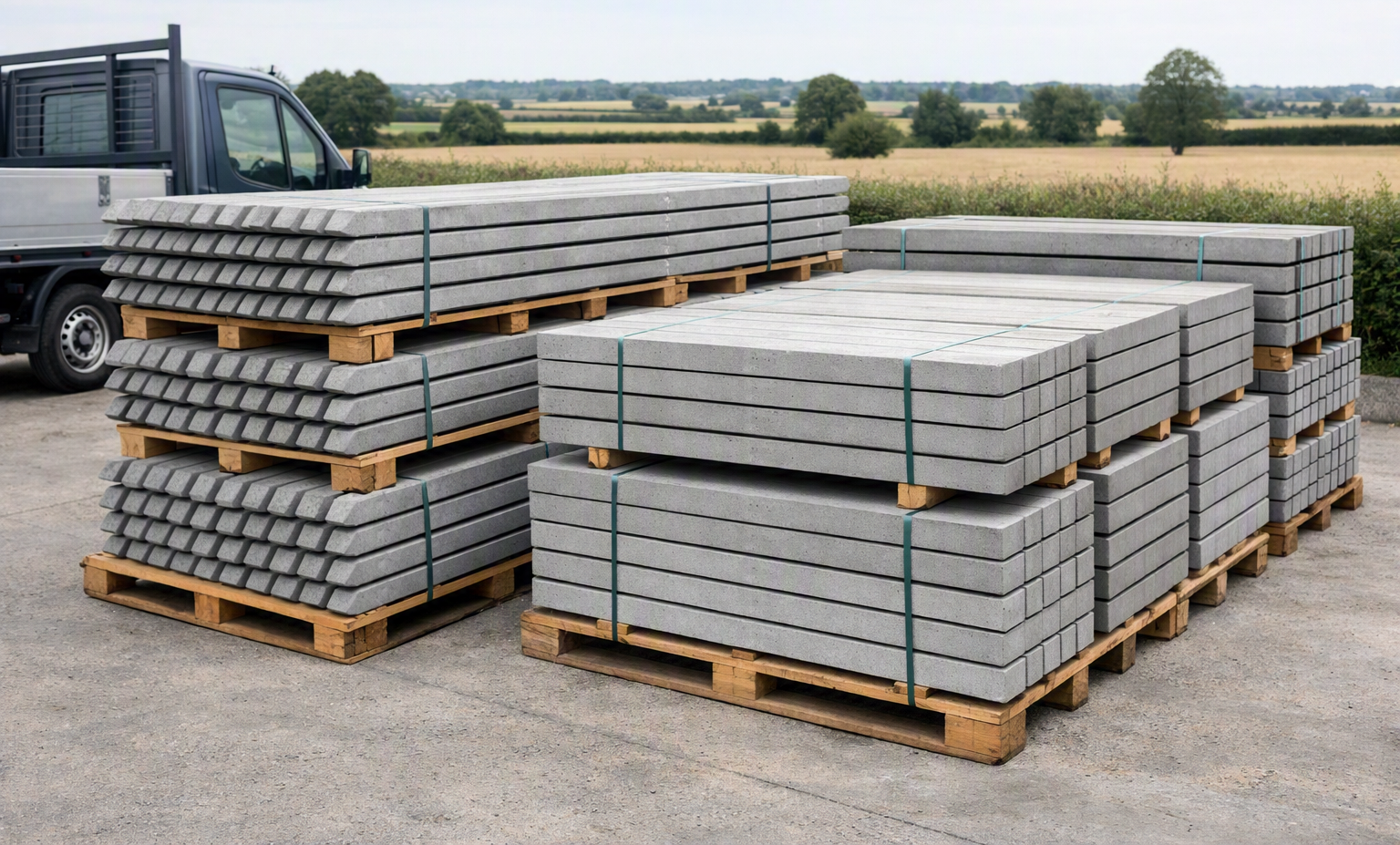
Concrete fencing for farms and rural properties comes down to one thing: it is built to be checked once and left alone, even on the longest, most exposed boundary. Whether you are enclosing a paddock, marking a field edge, or replacing tired timber along a rural driveway, steel-reinforced concrete posts and gravel boards give a working farm one less thing to worry about. We supply concrete fence posts, gravel boards and concrete slabs from our base near Gainsborough, with delivery across Lincolnshire, South Yorkshire and North Nottinghamshire, and trade and bulk pricing for farms and agricultural buyers.
Fencing a farm or rural boundary?
Tell us the length of your run and we will work out exactly what you need, with trade and bulk pricing available. Call or WhatsApp us on 07989 192742, or drop us a message for a straight answer from a supplier near Gainsborough.
Get a Quote