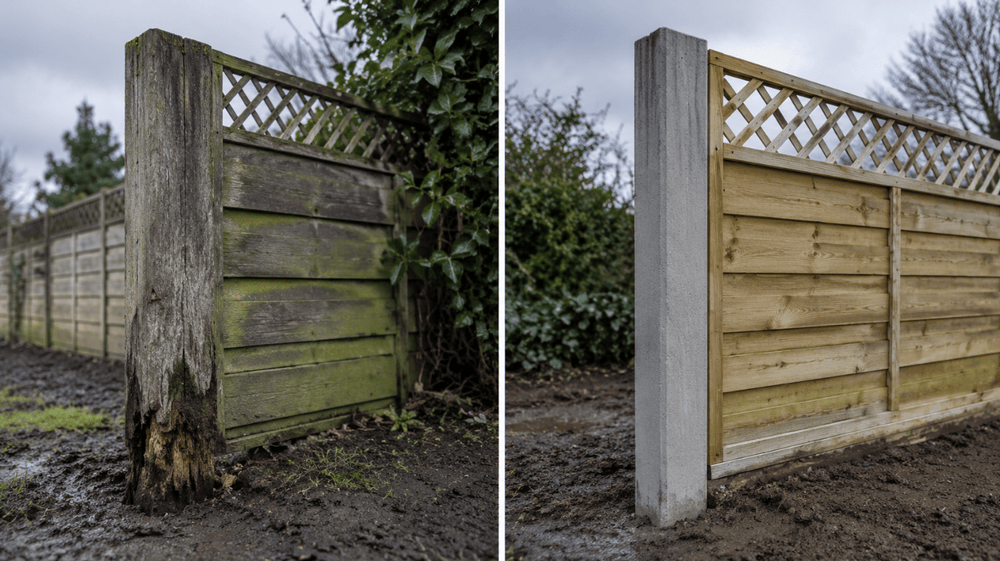
When you are planning a new fence, one choice shapes everything that follows: concrete fence posts vs timber. It decides how long the fence lasts, how much work it needs over the years, and how it copes with the wet, windy weather we get across Lincolnshire and the East Midlands. Timber posts are cheaper on the day and look natural, but they have a habit of rotting at the base. Concrete posts cost a little more upfront and last far longer. As a supplier of steel-reinforced concrete fence posts to homeowners and trade near Gainsborough, this is the comparison we are asked to settle almost every week, so here is a straight answer.
Concrete Fence Posts vs Timber: The Short Answer
Concrete fence posts last far longer than timber. A good steel-reinforced concrete post will stand firm for thirty years or more with no maintenance, while a timber post typically starts to rot and weaken within ten to fifteen years, often sooner where it meets the ground. If longevity is what matters most to you, concrete wins comfortably. Timber can still be the right choice for a short-term fence or a purely natural look, but it will need replacing several times over the life of a single concrete post.
Why Timber Fence Posts Fail
Timber is a natural material, and that is exactly why it struggles in the ground. The weak point is always where the post meets the soil. Even pressure-treated timber eventually lets moisture in, and once rot takes hold at the base the post loses its grip and snaps in the first strong wind. Damp ground speeds this up, and the heavy clay soils common around Gainsborough and the wider East Midlands hold water for long spells, which is hard on buried timber.
On top of rot, timber posts warp, twist, and split as they dry and swell through the seasons. That movement loosens fixings and can knock a fence line out of true. Insects and fungal decay do the rest. None of this is a fault of poor workmanship. It is simply what happens when you bury wood in wet ground for years.
Why Concrete Fence Posts Last Longer
Concrete does not rot, warp, or feed insects. A steel-reinforced concrete post is designed to sit in the ground indefinitely, shrugging off the damp that destroys timber. The steel reinforcement inside gives it the tensile strength to resist cracking under wind load, while the concrete itself is immune to the moisture, fungus, and pests that attack wood.
Concrete posts also hold panels more securely. Most are slotted, so panels or gravel boards drop neatly into place and are held on both sides, spreading wind load across the whole run rather than relying on a handful of nails or brackets. Add a concrete gravel board at the bottom and the panels never touch wet ground at all, which protects the fence panels themselves as well as the posts.
Comparing the Cost Over Time
This is where the concrete fence posts vs timber question really turns. On the day you buy them, timber posts are cheaper, and that lower sticker price is what tempts many people. But the true cost of a fence is what you pay across its whole life, not just at the start.
- Timber: lower upfront cost, but expect to replace failed posts within 10 to 15 years, plus the labour of digging out rotten posts and refitting panels each time.
- Concrete: higher upfront cost, but one post typically outlasts two or three timber replacements, with no treatment, no painting, and no repairs in between.
Once you factor in replacement posts, hire of tools, and your own time, the concrete option usually works out cheaper over twenty or thirty years, and far less hassle. You can compare current rates on our prices page.
What About Looks and Maintenance?
Timber's main advantage is appearance. A freshly treated wooden post has a warm, natural look that some people prefer, though it fades and greys unless you re-treat it every year or two. Concrete posts have a plain, functional grey finish, but they are almost always paired with timber or composite panels, so the fence still reads as a normal wooden fence from a distance. The posts simply do the hard work out of sight.
On maintenance, there is no contest. Timber needs regular treating to slow the rot and keep it looking respectable. Concrete needs nothing at all. Once it is set, you can forget about it. For busy homeowners, farms, and rural boundaries where getting to the fence is a job in itself, that hands-off durability is a big part of the appeal.
Which Should You Choose?
If you want a fence you can put up once and leave alone for decades, concrete fence posts are the clear choice, especially on exposed sites or the damp clay ground common across Lincolnshire. If you are after the cheapest possible fence for a short-term need, or you specifically want an all-natural timber look and do not mind the upkeep and eventual replacement, timber has its place. For the vast majority of garden boundaries, farm fencing, and paddock edges we supply around Gainsborough and the East Midlands, concrete posts paired with concrete gravel boards give the best value and the least worry over time.
If you are weighing up your options, we are happy to talk it through with no pressure. Take a look at our concrete fence posts and gravel boards, or get in touch and we will help you work out exactly what your project needs.
Not sure whether concrete or timber suits your project?
Call or WhatsApp us on 07989 192742. We supply steel-reinforced concrete fence posts, gravel boards, and slabs across South Yorkshire, North Lincolnshire, and North Nottinghamshire from our base near Gainsborough. Advice is always free.
Get in Touch