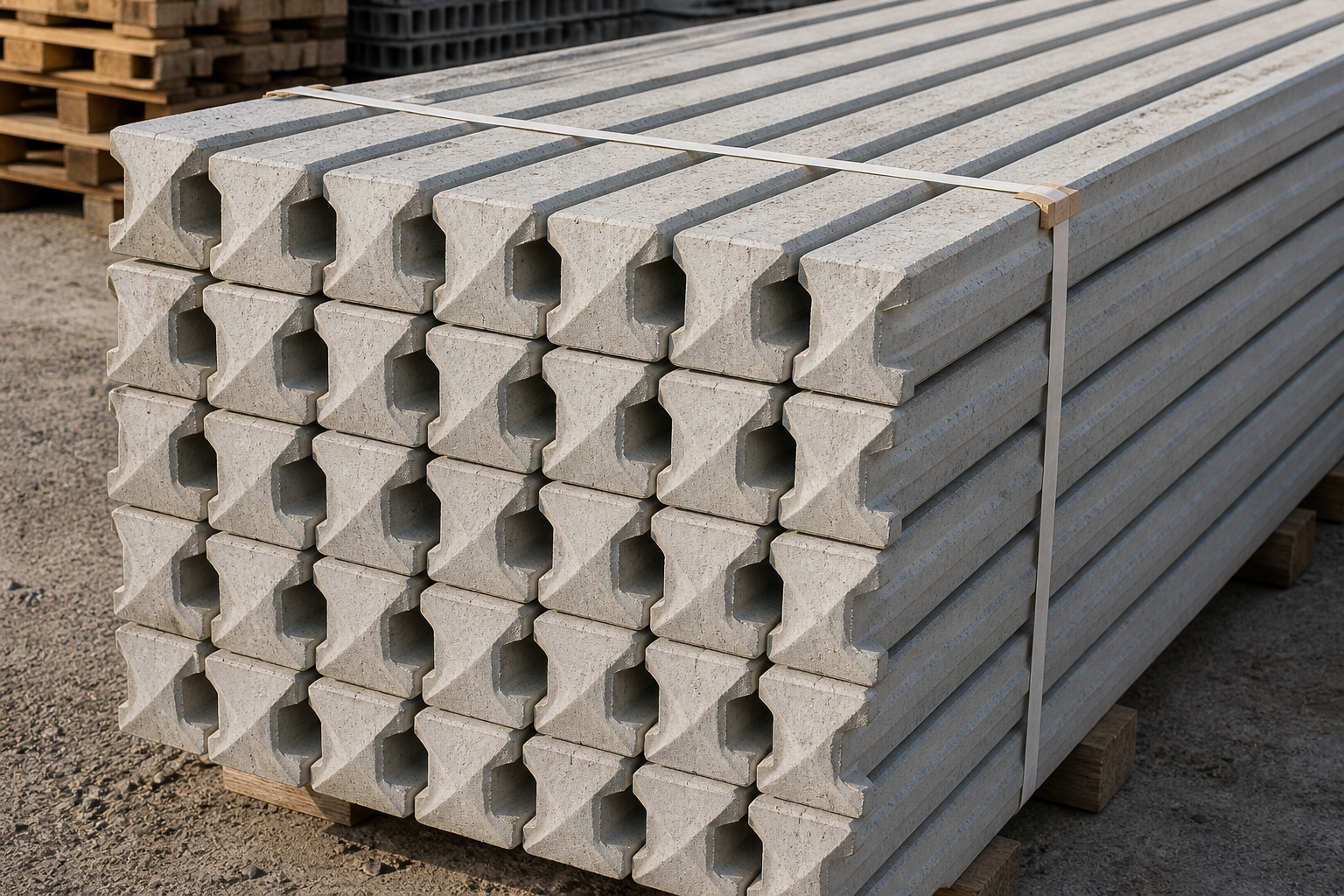
When people ring the yard to order posts, one of the most common points of confusion is the choice between slotted vs morticed concrete fence posts. They look similar stacked on a pallet, but they do two different jobs, and ordering the wrong type is one of the easiest ways to hold up a fencing project. This guide explains the difference between slotted and morticed concrete fence posts in plain English, so you can order with confidence, whether you are fencing a back garden in Gainsborough or a field boundary out across rural Lincolnshire.
What Is a Slotted Concrete Fence Post?
A slotted concrete fence post has a continuous groove, or slot, running down each face where a panel needs to sit. You simply slide a fence panel or a gravel board down into the slot from the top, and it is held firmly in place by the post on either side. Nothing is nailed or screwed; the weight of the panel and the grip of the slot do the work.
Slotted posts are the most popular choice for standard panel fencing, which is what most homeowners are putting up. They are quick to build with, they let you drop panels in and out for repairs without dismantling the whole run, and they suit lap panels, closeboard panels and concrete gravel boards. For the majority of garden fences we supply, a slotted concrete fence post is exactly the right tool for the job.
What Is a Morticed Concrete Fence Post?
A morticed concrete fence post has holes, or mortice slots, cast through the post rather than a continuous groove down the face. These holes are made to take horizontal timber arris rails, which then carry vertical feather edge boards. In other words, a morticed post is built for traditional feather edge (closeboard) fencing rather than ready-made panels.
Morticed posts are common on rural and agricultural boundaries, and anywhere a stronger, more solid feather edge fence is wanted. If you are building the fence board by board rather than dropping in a factory-made panel, a morticed post is usually what you need. Because feather edge fencing suits paddocks, smallholdings and open country, morticed posts see plenty of use across the farmland around the East Midlands.
Slotted vs Morticed: The Key Differences
Put side by side, the practical differences between slotted and morticed concrete fence posts come down to how the fence is put together:
- How the fill is held: a slotted post grips whole panels in a groove; a morticed post takes arris rails through cast holes.
- Type of fence: slotted suits panel fencing; morticed suits feather edge or closeboard fencing.
- Speed of build: slotted panels drop straight in and go up fast; morticed feather edge is slower but very robust.
- Repairs: a damaged panel lifts out of a slotted post easily; a feather edge board on a morticed post is replaced board by board.
- Look: panel fencing looks neat and uniform; feather edge has a more traditional, solid appearance.
Neither is better overall. The right answer to slotted vs morticed simply depends on the style of fence you are building. If you have already bought panels, you want slotted. If you are working with arris rails and feather edge boards, you want morticed.
End, Corner and Intermediate Posts
Once you know whether you need slotted or morticed, there is one more thing to get right: the type of post for each position in the run. Both slotted and morticed posts come in three variants.
- Intermediate posts: these have slots or mortices on two opposite faces, so a panel sits on each side. Use these for the main length of a straight fence.
- End posts: these have a slot or mortice on one face only, for where a fence stops against a wall or a building.
- Corner posts: these have slots or mortices on two faces set at 90 degrees, for where the fence turns a right angle.
A typical straight garden fence needs two end posts and a line of intermediate posts in between. Add a corner post wherever the boundary changes direction. Getting the count right before you order saves a second trip; our guide on how many concrete fence posts you need walks through the sums, and if you are unsure on heights, what size post you need for 6ft panels is worth a look too.
Which Should You Order?
For most homeowners putting up a standard 6ft panel fence, slotted intermediate posts with a slotted end post at each end is the answer. If you are laying feather edge fencing on a rural or paddock boundary, order morticed posts to match your arris rails. Whichever you choose, pairing the posts with a concrete gravel board at the base keeps the bottom of the fence off the wet ground and stops rot, which matters through the damp winters we get here in Lincolnshire.
If you are still weighing up materials in the first place, our comparison of concrete fence posts versus timber explains why concrete lasts so much longer, and you can see current rates on our prices page.
Get the Right Posts First Time
So, slotted vs morticed concrete fence posts? Slotted is for slide-in panels and is what most garden fences use; morticed is for feather edge fencing built on arris rails, and is common on rural boundaries. Once you have picked the style, order the right mix of intermediate, end and corner posts for your run, and add gravel boards to protect the base. Get those choices right and the fence goes up quickly and stands straight for decades. We supply steel-reinforced slotted and morticed concrete fence posts, gravel boards and concrete slabs from our base near Gainsborough, with delivery across Lincolnshire, South Yorkshire and North Nottinghamshire.
Not sure which posts you need?
Tell us the style, length and height of fence you are planning and we will tell you exactly which posts and how many to order. Call or WhatsApp us on 07989 192742, or drop us a message, and get honest advice from a supplier near Gainsborough.
Get in Touch