It is one of the first questions we get asked at the yard: do concrete fence posts need concrete footings, or can you just ram them into the ground and hang the panels? The short answer is that yes, in almost every case a concrete fence post needs a concrete footing to stay solid and upright for the long haul. A concrete post is heavy, it acts as a lever every time the wind catches the panels, and without a proper footing it will lean, twist or work loose within a few seasons. This guide explains why the footing matters, what to use, and the handful of situations where you might get away with something else, based on the jobs we supply every week around Gainsborough and across Lincolnshire.
Why Concrete Fence Posts Need Concrete Footings
A fence is really a row of levers. The panels catch the wind like sails, and all of that force is passed down into the posts and then into the ground. A timber post can sometimes rely on its own grip in the soil, but a concrete fence post is far heavier and stiffer, so it puts more strain on whatever is holding its base. Set one in bare soil and the ground around it compresses over time, the post starts to rock, and before long the whole run looks tired and uneven.
A concrete footing spreads that load across a much wider area underground and locks the base of the post in place. Here in the East Midlands, where a lot of gardens and paddocks sit on heavy clay that swells when wet and shrinks in a dry summer, that footing is what stops the post shifting as the ground moves through the year. It is the single biggest factor in whether a fence still looks straight in ten years or not.
Postcrete or a Standard Concrete Mix?
Once you have accepted that concrete fence posts need concrete footings, the next question is what to fill the hole with. There are two common choices.
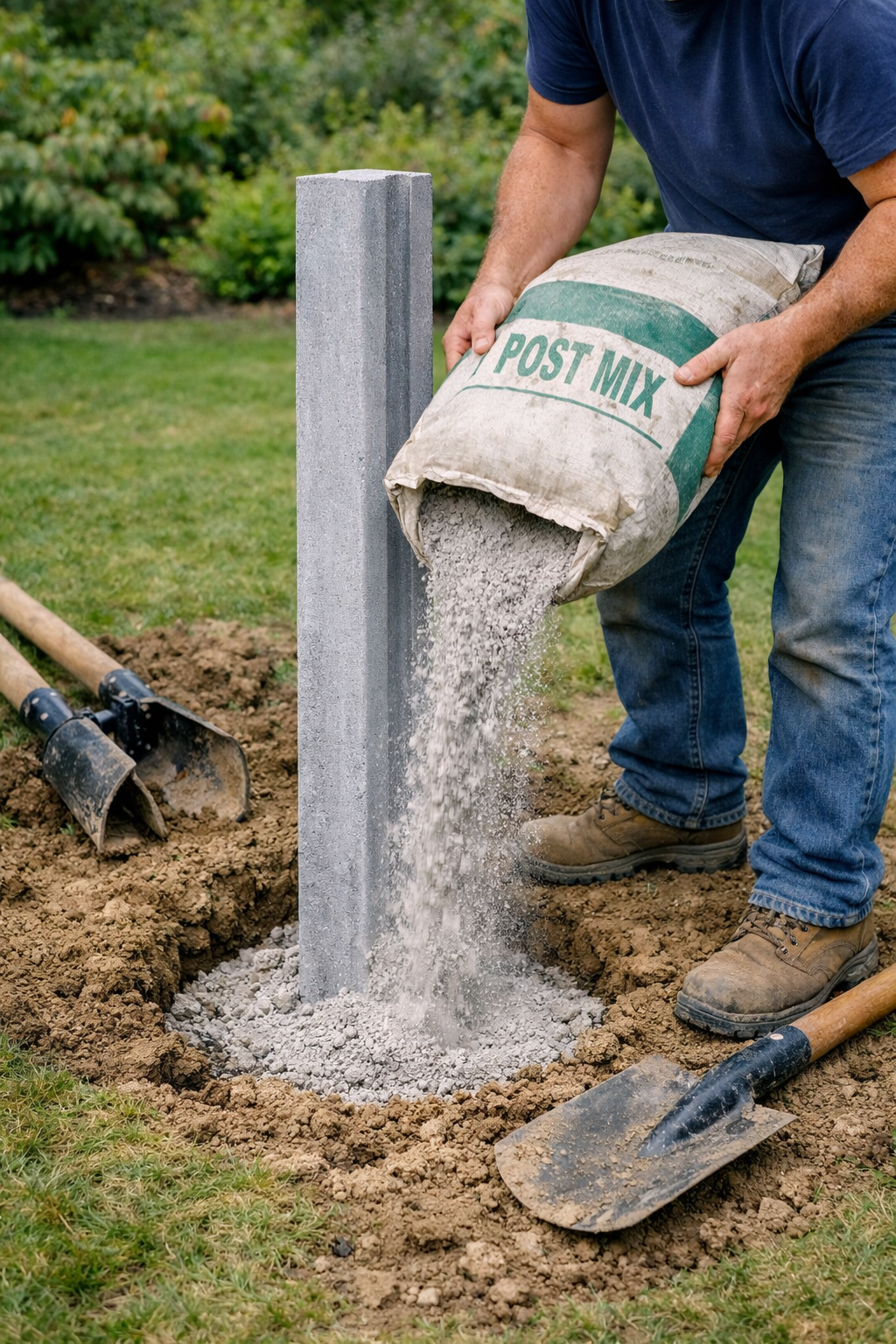
- Postcrete (fast-setting mix): you pour water into the hole, tip in the dry postcrete, and it goes off in five to ten minutes. It is quick, needs no mixing, and is ideal when you are setting a run of posts and want to keep moving. Most DIY installs use it.
- Ballast and cement (standard mix): a traditional mix of around 5 parts ballast to 1 part cement, mixed to a firm consistency. It takes longer to set and needs mixing, but it is cheaper per post on a big job and gives a very strong footing.
Both do the job. Postcrete wins on speed and convenience for most garden fences; a mixed footing is often preferred by trade on larger runs where the cost per post adds up. Whichever you use, the key is to work it down around the post to knock out air pockets and finish the top slightly proud and sloped away from the post so rainwater sheds off rather than pooling at the base.
How Much Concrete and How Deep?
A footing only works if the hole is the right depth and width. As a general rule, about a quarter to a third of the post should be below ground. For a standard 6ft fence that means a post roughly 600mm into the ground, in a hole around 300mm wide, so there is a decent collar of concrete all the way round. Taller fences and exposed, windy sites need to go deeper still.
Put 75mm to 100mm of compacted hardcore in the base of the hole before the post goes in. That gives the post something firm to sit on and, just as importantly, lets water drain away from the very bottom of the post rather than sitting against it. We cover the numbers in more detail in our guide on how deep concrete fence posts should be set, and if you are still choosing post heights, what size post you need for 6ft panels is worth a read too.
When Can You Skip a Concrete Footing?
There are a few limited situations where a full concrete footing is not essential, though they are the exception rather than the rule:
- Temporary fencing: if a fence is only going up for a season, posts rammed into firm ground with well-compacted hardcore may hold for the short term.
- Very low fences or non-structural posts: a short decorative post carrying little wind load asks far less of its base than a full-height panel fence.
- Solid rock or extremely compact ground: rare in most of Lincolnshire, but where a post can be wedged into stable rock, a full footing adds less.
For a normal garden or field boundary with 6ft panels, none of these apply. If you want the fence to stand straight through the winter gales that sweep across open Lincolnshire farmland, concrete the posts in properly and do not cut the corner.
Common Footing Mistakes to Avoid
Most of the failed fences we get called about come down to a small number of avoidable errors at the footing stage:
- Digging the hole too shallow, so the post has no leverage to resist the wind.
- Skipping the hardcore, leaving the post sitting in a puddle at the bottom of the hole.
- Not bracing the post while the concrete sets, so it dries out of plumb.
- Loading the fence with panels before the footing has cured.
- Finishing the concrete flat or dished, so water collects around the post instead of running off.
Get the depth, the hardcore, the bracing and the curing right and a concrete post set in a concrete footing will comfortably outlast the panels it carries. Fitting a concrete gravel board at the bottom of each bay then keeps the panels off the wet ground and protects the whole fence from rot.
Get the Right Materials First Time
So, do concrete fence posts need concrete footings? For any fence you want to last, the answer is a firm yes. The footing is what turns a heavy lump of concrete into a post that stays plumb through years of Lincolnshire weather. Get the depth right, sit the post on hardcore, set it in postcrete or a firm mix, brace it while it cures, and you have a fence that will not need touching for decades. We supply steel-reinforced concrete fence posts, gravel boards and concrete slabs from our base near Gainsborough, with delivery across Lincolnshire, South Yorkshire and North Nottinghamshire, and you can check current rates on our prices page.
Planning a new fence?
Tell us the length and height you are after and we will help you work out how many posts, panels and gravel boards you need. Call or WhatsApp us on 07989 192742, or drop us a message, and get honest advice from a supplier near Gainsborough.
Get in Touch