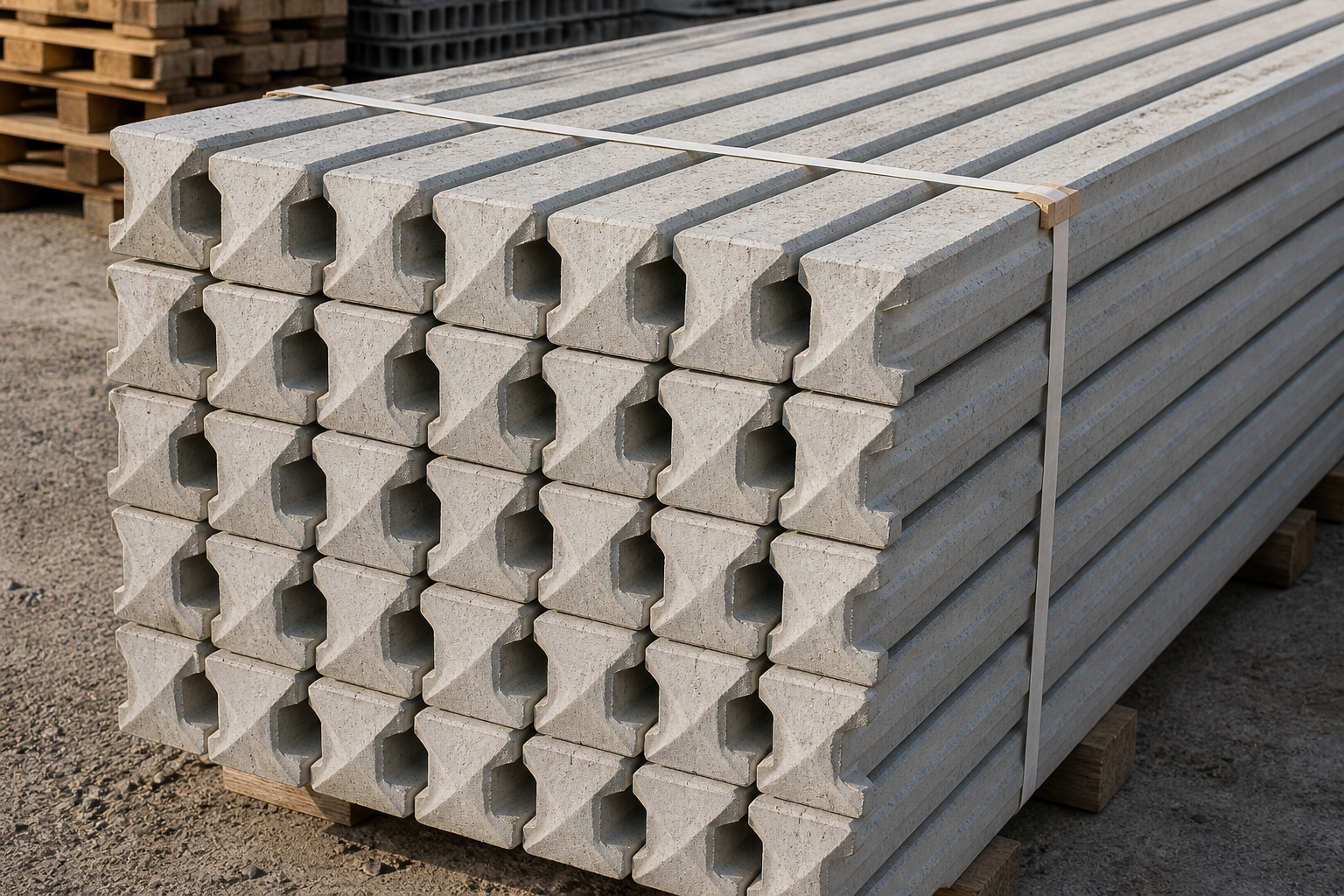
If there is one question that decides whether a fence stands firm for decades or leans over in the first winter gale, it is this: how deep should concrete fence posts be set? Get the depth right and the fence will shrug off wind, rain, and the heavy clay ground so common across Lincolnshire. Get it wrong and no amount of quality panels will save you. As a supplier of steel-reinforced concrete fence posts to homeowners and trade across the East Midlands, it is the question we answer most often, so here is a clear, no-nonsense guide.
The One-Third Rule for Concrete Fence Post Depth
The simplest way to work out how deep a concrete fence post should go is the one-third rule: roughly one third of the total post length sits below ground, and two thirds shows above it. This is the standard used across the fencing trade, and it holds true for the vast majority of domestic fences.
So for a 6ft (1.83m) high fence, you would use a 8ft (2.4m) post and set roughly 600mm to 750mm into the ground. That leaves about 1.8m standing proud to carry your panels. The remaining depth anchors the post against the leverage that wind puts on the fence, which is far greater than most people expect.
Post Depth by Fence Height
Different fence heights call for different post lengths and hole depths. Here is a straightforward reference for the most common jobs:
- 3ft to 4ft fence: use a 6ft (1.8m) post set around 450mm deep.
- 5ft fence: use a 7ft (2.1m) post set around 600mm deep.
- 6ft fence: use an 8ft (2.4m) post set around 600mm to 750mm deep. This is the most popular size we supply across Lincolnshire.
- 8ft fence: use a 10ft (3.0m) post set around 900mm deep, and consider a wider hole for extra stability.
The taller the fence, the more wind load it catches, so deeper and more substantial footings become important. If in doubt, go a little deeper rather than a little shallower. It costs a bit more concrete but it is far cheaper than resetting a leaning fence a year later.
How Wide Should the Hole Be?
Depth is only half the story. The hole also needs to be wide enough to hold a decent collar of concrete around the post. As a guide, dig the hole around three times the width of the post. For a standard 100mm x 100mm concrete post, that means a hole roughly 300mm across. This gives the post-mix concrete enough mass to grip the ground and resist movement.
A narrow, tight hole with only a thin skin of concrete around the post will never perform as well, no matter how deep you go. Width and depth work together.
Do You Need Concrete Around the Posts?
For concrete fence posts, yes. Setting them in a postcrete or a proper concrete mix is what gives them their strength and longevity. Simply backfilling with soil or hardcore will not hold a post against wind and time. Fill the hole with a firm, well-compacted mix, checking the post for plumb with a spirit level as you go, and slope the top of the concrete slightly away from the post so water drains off rather than pooling around the base.
Allow the concrete to cure before loading the post with panels. In most conditions 24 to 48 hours is enough for the mix to set firm, though full strength takes longer. If you are also fitting gravel boards and panels, wait until the posts are solid before sliding them in.
Extra Considerations for Lincolnshire Soils
Ground conditions matter, and the heavier clay soils found in and around Gainsborough and the wider East Midlands behave differently to light, sandy ground. Clay holds water and can shift as it swells and shrinks through the seasons, so we generally advise erring towards the deeper end of the range and making sure the concrete collar is generous. If you are working on very soft, waterlogged, or made-up ground, going deeper still, or widening the hole, is a sensible precaution.
Exposed, windy sites such as open fields and rural boundaries also warrant extra depth. A fence in a sheltered back garden faces far less load than one running along an open farm boundary, where wind can hit it full force from every direction.
How Deep Should Concrete Fence Posts Be? The Bottom Line
To sum up how deep concrete fence posts should be set: aim for around one third of the post in the ground, which for a typical 6ft fence means burying a 2.4m post about 600mm to 750mm deep in a hole roughly 300mm wide, set in concrete. Go deeper for taller fences, exposed sites, and the heavier clay soils common across Lincolnshire. Done properly, a steel-reinforced concrete post set to the right depth will hold your fence straight and solid for thirty years or more, with no rot and no maintenance.
If you need help working out post lengths and quantities for your project, we are always happy to talk it through. Take a look at our concrete fence posts and current prices, or get in touch and we will point you in the right direction.
Not sure what post length or depth you need?
Call or WhatsApp us on 07989 192742. We supply steel-reinforced concrete fence posts, gravel boards, and slabs across South Yorkshire, North Lincolnshire, and North Nottinghamshire from our base near Gainsborough. Advice is always free.
Get in Touch