
Concrete fence posts are built to outlast almost everything else in the garden, but they are not indestructible. A reversing trailer, a fallen branch, a gale coming across open Lincolnshire farmland, or simply an old post that was never set deep enough can leave you with a snapped stump and a sagging panel. Knowing how to replace a broken concrete fence post properly means you can fix one bay without dismantling the whole run. This guide walks through the job from start to finish, based on what we see week in and week out supplying concrete fence posts to homeowners and trade around Gainsborough.
First, Work Out Whether the Post Really Needs Replacing
Not every damaged post is a write-off. Before you order anything, take a proper look at what has actually failed.
- Snapped clean through: if the post has broken across its width and you can see the steel reinforcement bars, it has to be replaced. There is no reliable repair for a post that has lost its reinforcement.
- Surface chips and hairline cracks: cosmetic damage to the face of a post is usually harmless. If the post is still solid and plumb, leave it alone.
- Leaning but intact: a sound post that has worked loose in soft ground often just needs digging out and resetting in fresh concrete, not replacing.
- Cracked at ground level: this is the classic failure point and it almost always means replacement, because that is where the post carries the most load.
What You Will Need
Replacing a broken concrete fence post is a two person job on most fences, mainly because concrete posts are heavy and the panels either side need supporting while you work. Gather this lot before you start:
- A matching replacement post of the correct height and type (intermediate, end or corner)
- Spade, post hole digger or grafter, and a crowbar or digging bar
- Timber props or spare battens to support the panels either side
- Postcrete or a ballast and cement mix, plus hardcore for the bottom of the hole
- Spirit level, tape measure and string line
- Gloves, safety boots and eye protection
Order the post first and check it against the one coming out. Post type matters more than people expect: an intermediate post is slotted on both sides, an end post on one side only. If you are unsure which size you need, our guide on what size concrete fence post you need for 6ft panels covers the standard heights.
Step One: Support the Panels and Free the Post
Start by taking the weight off. Prop both neighbouring panels with timber battens driven into the ground at an angle, so nothing drops when the post comes out. Then slide the panels out of the slots on the broken post. Because concrete posts are slotted rather than fixed, panels usually lift straight up and out, though a panel that has been in place for years may need easing with a bit of persuasion from below.
If there is a gravel board in the bay, lift that out too and set it aside. Keep everything you remove flat and out of the way, because a leaning concrete panel or gravel board is a hazard.
Step Two: Dig Out the Old Concrete Footing
This is the part that takes the time. The broken stump will still be locked into a lump of concrete underground, typically 600mm or so deep with a football sized mass of concrete around it. Dig a trench around the footing to expose the sides, then work a crowbar underneath and lever it out. Rocking the stump back and forth loosens the bond, and on wet Lincolnshire clay a bucket of water poured into the trench often helps free it.
If the footing will not shift as one piece, break it up with a sledgehammer or a breaker, taking out the concrete in chunks. Wear eye protection, because concrete shards fly. Clear all the old material out of the hole; leaving broken lumps in there stops the new post sitting square and weakens the new footing.
Step Three: Set the New Concrete Fence Post
Dig the hole out to a proper depth before the new post goes in. As a general rule, around a quarter to a third of the post should be buried, which for a standard 6ft fence means roughly 600mm in the ground. Take the chance to go deeper than the original if the old post failed because it was set too shallow.
- Put 75mm to 100mm of hardcore in the base of the hole and compact it, so water drains away from the foot of the post.
- Stand the new post in the hole and check the height against a string line run from the posts either side, so the top lines up with the rest of the fence.
- Brace the post with timber props and check it is plumb on two faces with a spirit level. Also check the slots are square to the fence line, or your panels will not slide back in.
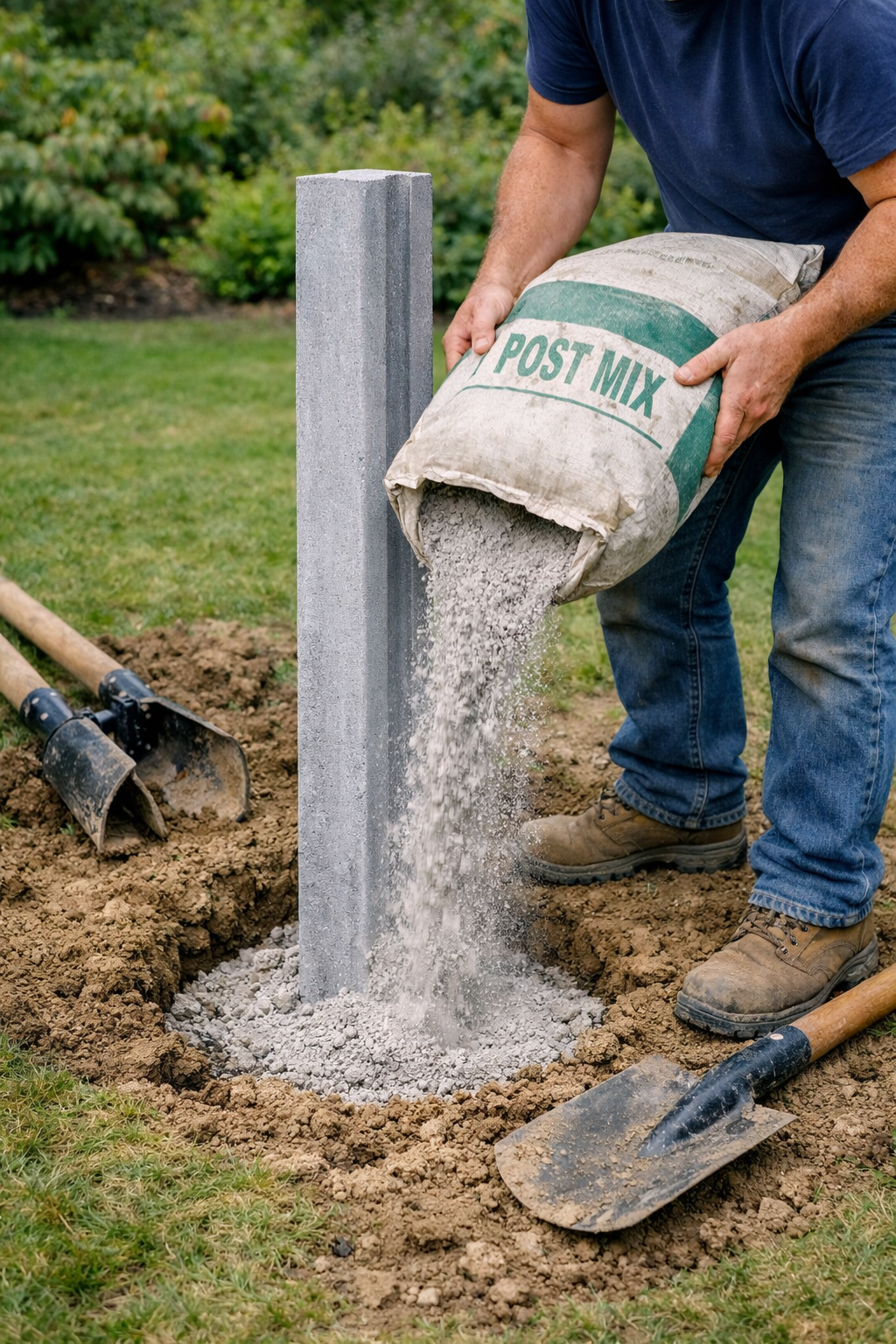
- Pour in water then postcrete, or fill with a stiff concrete mix, working it down around the post to remove air pockets. Finish the top of the concrete slightly proud and sloped away from the post to shed rainwater.
- Leave the props in place and let the concrete cure before you touch it. Postcrete sets in under an hour but give it a few hours before loading it, and let a standard mix cure overnight.
For a fuller explanation of depths and footings, see our article on how deep concrete fence posts should be set.
Step Four: Refit the Panels and Gravel Board
Once the concrete has gone off, drop the gravel board back into the slots first, then lower the panels in from the top. If the panels are a tight fit, that is a good sign the post spacing is right. If there is a noticeable gap, a timber batten fitted inside the slot takes up the slack neatly. Remove the props, backfill any open ground around the footing, and firm the soil down.
Stopping It Happening Again
Most replacement jobs we supply across Lincolnshire and the East Midlands come down to two causes: posts set too shallow, and panels sitting directly on wet ground so the fence takes more strain than it should. Setting the new post deeper and fitting a concrete gravel board under each panel fixes both. It is also worth checking the rest of the run while you are there. If one post has failed from age or shallow footings, its neighbours are often not far behind, and replacing two at once saves a second delivery.
You can see current rates for posts, panels and gravel boards on our prices page, and we also supply concrete slabs if you are tidying up a base or pathway at the same time.
Need a Replacement Post?
Knowing how to replace a broken concrete fence post is mostly about patience with the old footing and care setting the new one. Get the depth right, keep it plumb, and the replacement will outlast the rest of the fence. We keep steel-reinforced posts in stock in all the common heights near Gainsborough, so a single replacement post is never a problem, and we deliver across Lincolnshire, South Yorkshire and North Nottinghamshire.
Got a broken post to replace?
Call or WhatsApp us on 07989 192742 and tell us the height and type you need. We supply single replacement posts as happily as full loads, along with gravel boards and slabs, from our base near Gainsborough. Advice is always free.
Get in Touch