One of the most common questions we get at Premier Concrete Fencing is: how do I actually install concrete fence posts? It is a fair question. Concrete posts are heavier than timber, and if you have not done it before, the process can seem a little daunting. The good news is that slotted concrete fence posts are genuinely straightforward to install - and once they are in, you will not need to touch them again for decades. Here in Lincolnshire and across the East Midlands, where soils can be heavy and wet, getting the installation right makes all the difference to how long your fence lasts.
What You Will Need Before You Start
Before you begin, gather everything you need so the job flows smoothly. For a standard residential fence run using slotted concrete fence posts, you will need:
- Slotted concrete fence posts (one more than the number of panels)
- Concrete gravel boards (one per bay)
- Fence panels
- Post mix concrete (one bag per post is usually sufficient for average soils)
- A spade and post hole digger or a rented electric post-hole borer
- A spirit level
- A string line and pegs
- Tape measure
- A bucket of water (for the post mix)
- A rubber mallet
- A willing helper - concrete posts are heavy
Before you dig a single hole, check for underground cables and pipes. Call 0800 023 2023 (the free 'dial before you dig' service) or use an online mapping tool if you are in any doubt. This is especially important in the East Midlands, where older rural properties can have unmarked services running through gardens.
Step 1: Mark Out Your Fence Line
Start by marking the exact line your fence will follow. Hammer a peg in at each end of the run and stretch a string line tightly between them. This gives you a straight reference line to work from throughout the job.
Standard fence panels are 6 feet (1.83m) wide. Your post centres should be slightly less than this - roughly 1.83m apart - so the panel fits snugly into the slots without being forced. Measure and mark each post position along the string line before you begin digging. Getting this right at the start saves a lot of frustration later.
Step 2: Dig the Post Holes
The golden rule for how to install concrete fence posts is depth: one third of the total post length should be below ground. For an 8ft post (the standard choice for 6ft fence panels with a gravel board), that means a hole roughly 2ft 6in deep. In soft, sandy, or clay-heavy soils - common across Gainsborough and much of Lincolnshire - go a little deeper for added stability, or consider a slightly wider hole to give the concrete more grip.
A post-hole borer makes this much faster and less tiring than a spade alone. Hire one for the day if you have more than a few posts to set - it is well worth the money.
Step 3: Set the First Post
Place your first post in its hole and use the string line to position it correctly. Get a helper to hold the post upright while you check it is plumb (perfectly vertical) with a spirit level on two adjacent faces. This is the most critical step - if the first post is not true, every post that follows will be slightly out.
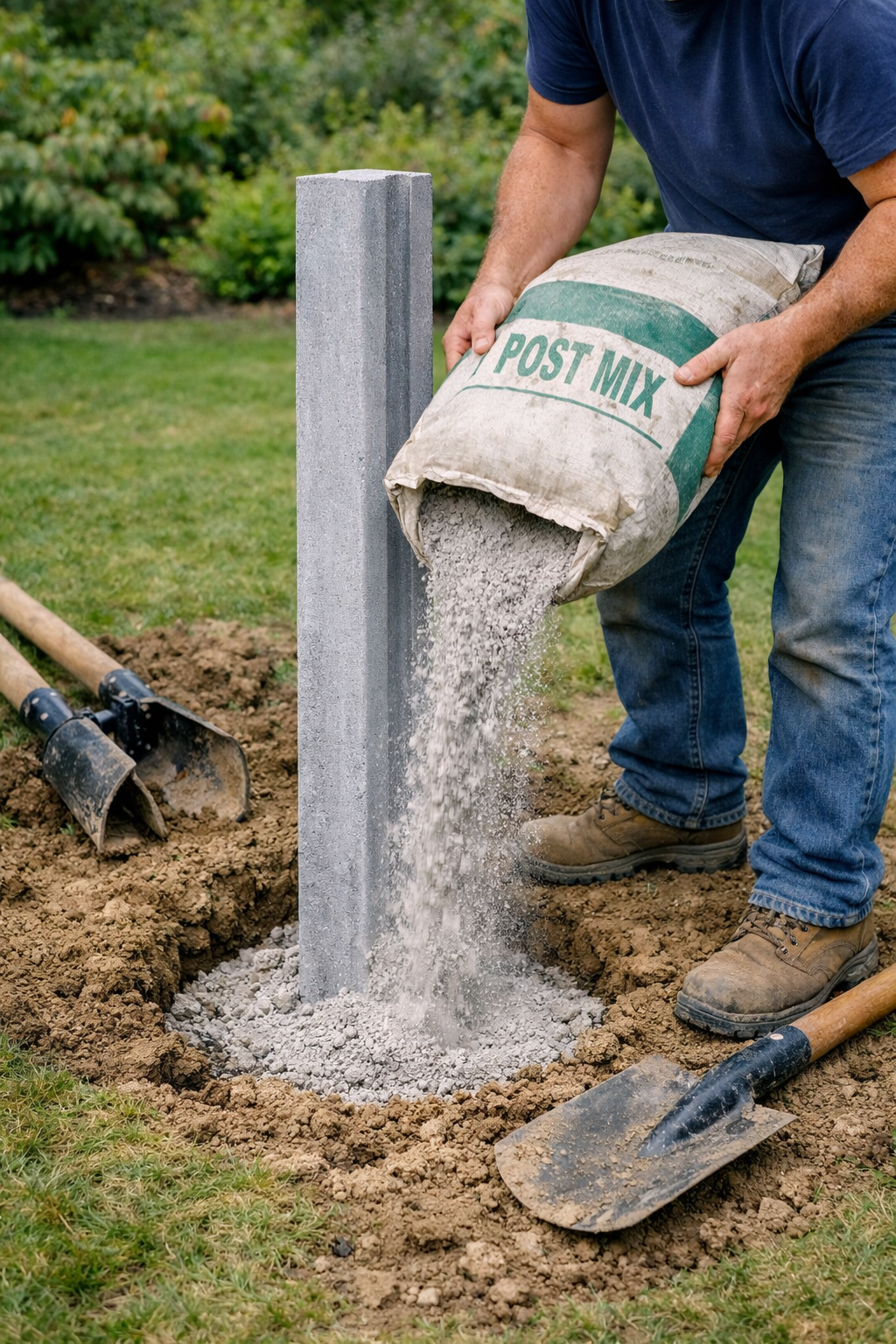
Once you are happy the post is correctly positioned and plumb, pour your post mix dry into the hole around the post (following the manufacturer's instructions) and add water as directed. Post mix sets quickly - usually firm enough to continue within 10 to 20 minutes, though leave it to cure fully overnight before loading it with heavy panels if you can. Backfill any gap above the concrete with soil and firm it down.
Step 4: Fit the Gravel Board and Slide in the First Panel
Once your first post is set and firm, you can begin building the fence. Slide a concrete gravel board into the lower slot of the post. Gravel boards sit at ground level and protect the bottom of your fence panels from rising damp and soil contact - they are an essential part of a long-lasting fence. Check it is sitting level.
Now slide your first fence panel down into the upper slots of the post. Do not fully secure it yet - just rest it in position so you can align the next post before everything is fixed in place.
Step 5: Repeat Along the Run
Set your second post in the same way as the first: hole dug to the correct depth, post held plumb, post mix poured and watered. As you position the second post, make sure the panel slots align with the panel already in place, and that the post is correctly spaced from the first. The panel should slide cleanly into the slots on both posts without being forced or sitting loose.
Continue this process - post, gravel board, panel, post - until you reach the end of the run. Take your time checking each post for plumb and alignment before the post mix sets. Rushing this stage is the most common cause of a fence that looks wonky when you step back.
Tips for Installing Concrete Fence Posts in Lincolnshire Soils
The clay-heavy soils found across much of North Lincolnshire, North Nottinghamshire, and the East Midlands can move significantly with seasonal moisture changes - swelling in winter and shrinking in dry summers. This puts more stress on fence posts than lighter, well-drained soils do. To get the best results:
- Always dig to the recommended depth or slightly deeper in clay ground
- Use a full bag of post mix per post rather than cutting it short
- Make sure the concrete fills around the post evenly on all sides
- Allow posts to cure for at least 24 hours before hanging heavy panels in exposed or windy locations
- Avoid installing posts in waterlogged ground - let it drain first if possible
How Long Will Concrete Fence Posts Last?
Installed correctly, a quality steel-reinforced concrete fence post will outlast you. While timber posts typically need replacing within 10 to 15 years - especially in the wet soils common across Gainsborough and Lincolnshire - a properly set concrete post will still be standing decades later with zero maintenance required. You will not need to treat it, paint it, or check it. It simply gets on with the job.
See our concrete fence posts page for sizes and stock, or check our current prices. We also supply concrete gravel boards and concrete slabs if you need the full package.
Need help working out what size posts you need, or how many to order for your fence run? We are happy to help - just give us a ring or send a WhatsApp and we will talk you through it. We supply and deliver across North Lincolnshire, South Yorkshire, and North Nottinghamshire, including Gainsborough, Retford, Worksop, and Doncaster.
Call us on 07989 192742, send a WhatsApp, or use our contact form and we will get back to you the same working day.
Get a Quote